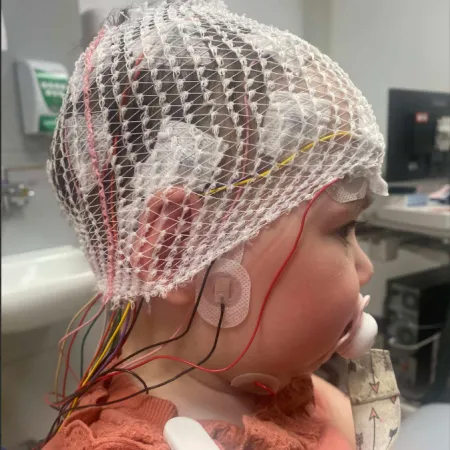
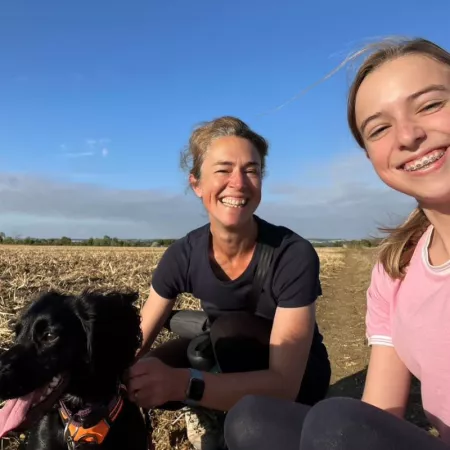
My daughter Ada was just six months old when she had her first seizure. The months that followed were frightening and overwhelming. Now I’m sharing our family’s story so other parents facing an epilepsy diagnosis know they are not alone.
One minute, you’re waiting for your baby to crawl...
Ada was six months old when she had her first seizure.
At first, we thought it might have been a febrile seizure. Her dad had experienced them as a child and we hoped it was something that might happen once and never happen again.
But shortly after returning home from hospital, Ada had four more seizures. She was admitted to hospital again and began having clusters of between five and ten seizures a day. Tests eventually showed seizure activity in the left temporal lobe of her brain, leading to a diagnosis of epilepsy.
For me, life changed almost overnight.
One minute you’re just waiting for your six-month-old to crawl or do something by themselves. But we were waiting for the next seizure and wondering if we were going to have to give lifesaving CPR.
Ada has stopped breathing during seizures and has needed resuscitation three times. Those early experiences were absolutely terrifying. Alongside learning how to care for a baby, my partner and I suddenly had to learn how to respond to seizures and give emergency care.
Even when a seizure was over, the fear did not simply disappear.
In the moment, you’re in fight or flight mode. You’ve got tunnel vision. You’re thinking, ‘I need to do this to make sure she’s OK.’ It’s afterwards that you think, ‘That’s my child.’
The experience left me dealing with significant trauma, at a time when I was also trying to care for Ada and my older daughter.

Learning to live with epilepsy
I found that there was medical support for Ada, but much less help available for me as a parent trying to understand what our new reality meant.
I wanted someone who could explain things clearly, understand what I had witnessed and help me learn how to live day to day with a baby with epilepsy. Instead, much of it felt like learning on the job.
I felt like I couldn’t even put her down in a cot so I could go to the toilet because I was too scared that something was going to happen.
For me, support for parents matters because looking after myself also helps me care for Ada.
I need to be able to cope so she can survive. I’m her lifeline.
Epilepsy affects much more than seizures
Today, epilepsy remains part of Ada’s everyday life.
We have been told that damage to Ada’s hippocampus following prolonged seizures is likely to be contributing to difficulties with speech, memory and emotions. She is non-verbal, although she communicates in her own ways and is beginning to copy and form more words.
Because Ada cannot always communicate what she needs or how she feels, it can be particularly difficult for her and for us when something is wrong.
Her epilepsy also influences the places we go and the routines we keep. Loud environments and getting too hot can sometimes be associated with her seizures, while medication and sleep need to stay closely managed. School trips require extra planning and, when Ada was younger, finding childcare that could accommodate her uncontrolled epilepsy was difficult.
Ada’s epilepsy is drug resistant. We spent around two years trying different medications. A treatment can work well for weeks or months before seizures begin to return, meaning another review and sometimes another change of medication. Surgery has also been discussed as a possible option in the future.
When you’re having a good few months, you do forget really. It feels like you haven’t got a child who’s got any problems. Then all of a sudden they come back.

Ada is so much more than epilepsy
But epilepsy is only one part of Ada’s story.
She is absolutely hilarious.
Ada loves singing and dancing. She loves The Wiggles and Ms Rachel and has an enduring fascination with people’s hair, gently holding and rubbing it against her face.
She is especially close to her older sister, Faye. And while Ada finds spoken communication difficult, singing is different. She sings the alphabet, Twinkle Twinkle and The Rainbow Song. We might understand the words better than other people do, but we know exactly what she is singing.
She is also cheeky, mischievous and a bit of a daredevil.
At school, Ada has even discovered that staring at the floor can make everyone think she is having a seizure. When somebody rushes over to check on her, she sometimes laughs or shouts “boo”. Her teachers know to keep an extremely close eye on her, but they also adore her sense of humour.
Although she’s a whirlwind, she’s the calm herself. She makes us realise that a lot of things are not that important.
Ada has changed our perspective as a family on the things that really matter.

Finding other families who understand
I discovered Young Epilepsy through social media after searching for information and seeing relatively few stories about babies and young children with epilepsy.
Finding a community of families living through similar experiences made a difference.
It lifts you. It pulls the weight off your chest in a way, because when you’re in the midst of something and it feels awful, you feel like you’re the only person going through it. But you’re not.
That feeling is one of the main reasons I wanted to tell our story.
I remember how frightening those first months were and hope another parent at the beginning of a similar journey might read about Ada and feel a little less alone.
I wanted to share our story to show that it is really scary, but it’s not going to be scary forever.
Life has gradually opened up again for us as a family.
For a long time, even something like taking Ada abroad seemed daunting. There was travel insurance to consider, managing her routine and medication, keeping her cool and the fear of what might happen somewhere unfamiliar.
Then, after a year of planning, we took our first family holiday abroad.
And it went well.
For me, moments like that are an important reminder that epilepsy does not mean life stops.
There are good days and there are bad days. Children are so resilient.
For a family somewhere at the beginning of their own epilepsy journey, that is exactly what I hope Ada’s story will show: life may look different from the one you expected, but you learn, adapt and find joy again.